If you’re considering a teaching job in Shanghai, most listings will tell you about hours, pay, and class sizes. Few will tell you how we teach writing, or why it works. At ThinkWriteSpeak, writing isn’t taught by instinct alone. We use a real, established framework, the 6 Traits of Writing, alongside the classic five-stage writing process. Here’s what that actually looks like in the classroom.
How We Teach Writing, at a Glance
- The process: every piece moves through prewriting, writing, revising, editing, and publishing
- The 6 Traits: Ideas, Organization, Voice, Word Choice, Sentence Fluency, Conventions, each one taught as a specific, learnable skill, not a vague sense of “good writing”
The Writing Process
Every piece of writing our students produce moves through the same five stages: prewriting, writing, revising, editing, and publishing. This structure traces back to writing researcher Donald Murray, whose 1972 essay “Teach Writing as a Process Not a Product” first argued that writing should be taught as a discovery process rather than judged only on the finished result, the idea that shaped how writing is taught in schools ever since. It’s a simple structure, but it’s the backbone of everything else below, students always know what stage they’re in and what the goal of that stage is.
To back this up in practice, every level has its own course book: worked example paragraphs, structured prewriting steps, and rubrics we use to actually assess a student’s progress against the traits below, not just a general sense of whether their writing “seems better.”
The 6 Traits of Writing
The 6 Traits framework was developed by Vicki Spandel and colleagues at what’s now Education Northwest (formerly the Northwest Regional Educational Laboratory), building on earlier 1960s research by Paul Diederich. It breaks good writing down into six specific, teachable skills, rather than treating “good writing” as some vague, unteachable talent. Here’s how we actually use each one.
Ideas
It’s all about choosing a great topic and the details you want to include. Before a student writes a word, we’re already discussing our ideas and getting them on the page. Gathering details before we write, the Ideas step is often closely connected to the prewriting step.
Organization
Making sure everything is in the right place. In practice, that means every paragraph gets a topic sentence, a body, and a closing sentence, and every essay gets a clear beginning, middle, and end.
One real example: a student was set a one-paragraph writing activity but submitted four paragraphs, structured like a full essay. She’d written it in a word processor, so the paragraph breaks were very obvious. In class, we simply removed the line spacing so it read as one continuous block, and she immediately said “Oh, yep. I get it!” Pairing that with an example from our writing textbook, showing a single indent for a single paragraph, made the concept click.
Voice
Voice is about not sounding like a robot. We teach students to add enthusiasm by asking the reader questions (engaging in dialogue with the reader), using colourful language like metaphors and similes, and recognising that the voice you use telling a personal story is different from the voice you use when presenting research or facts.
Word Choice
This one’s all about vocabulary. Worth knowing: in English exams, students are typically given more credit for attempting new, more advanced vocabulary, even if they make small mistakes using it, than for playing it safe with words they already know well.
Sentence Fluency
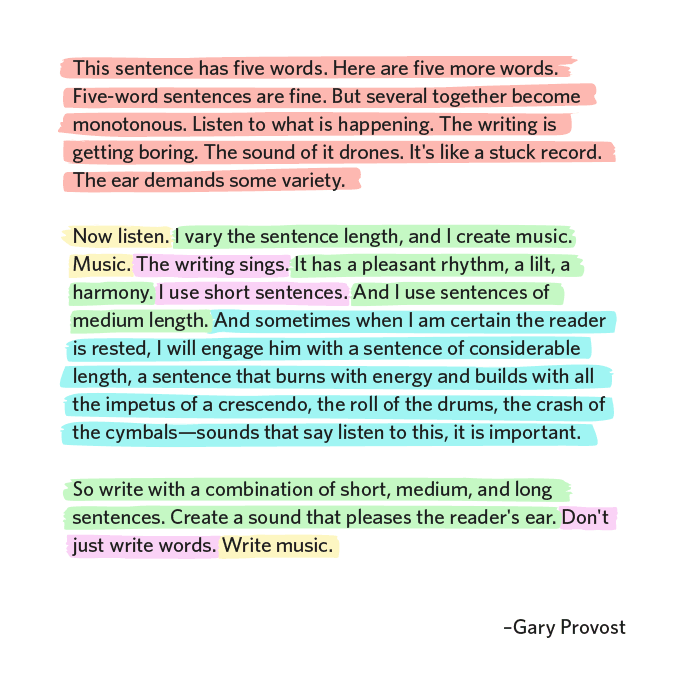
This is the flow of sentences, and there’s no better way to teach it than Gary Provost’s famous passage on the subject:
Conventions
A convention is a rule you must follow: spelling, grammar, capitalisation, punctuation. If you break the rules, you correct them, and that’s essentially the editing stage of the writing process in practice.
One thing students consistently respond well to: sharing a real book on screen to show dialogue rules, specifically, that a new line starts every time the speaker changes. We usually pull up a page from a book like Harry Potter and show every indent, one per speaker change, so students see the rule working in a real, familiar book rather than just being told it.
Since our students are learning English as a second language, some error patterns come up more than others, verb tenses and subject-verb agreement especially. We keep grammar homework light and optional by design, but when we notice a pattern like this repeating across a student’s work, we address it directly rather than letting it slide.
Reading That Reinforces the Writing
Our weekly reading homework isn’t just general practice, we deliberately choose passages that show the exact principle we’re teaching that week in class. One example: while covering order of location (describing a person systematically, head to toe, as part of Organization), we used a passage from Huckleberry Finn describing Huck’s father, which does exactly that. Students see the technique they’ve just learned being used by a real author, in a real book, the same week they’re practising it themselves.
This is how we teach writing at ThinkWriteSpeak: a real, structured approach, not a vague “help kids with English” job description. If that sounds like the kind of way you’d like to teach, we’re currently hiring.